|
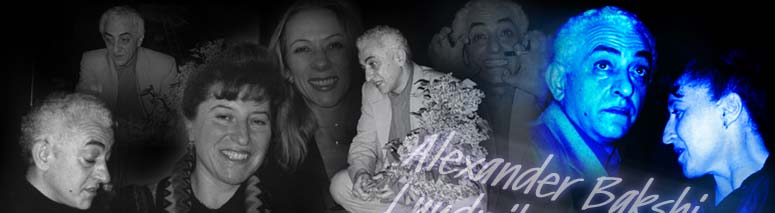
„Harmony is Dead: Long Live the New Age of Polyphony” The Moscow Times, May 24, 2001 By John Freedman I wonder, did you feel it? When last weekend, on Friday and Saturday, the world changed a little? It happened here in Moscow. At the Vakhtangov Theater. As a part of the International Theater Olympics. When nearly 100 musicians, actors, shamans and folklore specialists created a show that wreaked havoc with the laws of the performing arts. The show was “The Polyphony of the World.“ Its composer Alexander Bakshi calls it a mystery play, the latest work in a personal genre that he defines as the „theater of sound.” Its director Kama Ginkas states that it is neither a concert, an opera, nor a ballet, but that it is theater for there is action in it. Here is a pitifully inadequate description of what transpired. A kind of primal man was born from the bowels of the earth — boards were ripped up from the stage and he was yanked through the hole into the air by a rope, feet first. Soon, he was exposed to sounds giving him consciousness and identity. Some soothed, others menaced as they evolved into thundering fascist marches. These conflicting sounds accompanied the primal man to an end of fire, dust, water, air and inscrutable contemplation. The refined music of the European orchestra emerged from the simple sounds of nature and evolved into ebbing and flowing battles with musical traditions of other cultures. In one stunning moment of rebellion, the primal man demolished a violin with a rock. Some conservative spectators did not want to forgive the director this “barbarous“ act, but it was clearly, perhaps specifically, signaled in the composer's conception: The hegemony of European musical forms is at an end. Someone else will have to hang a label on this production where sound was transformed into a full-fledged character, where sound wholly determined the action, and where plot, such as it was, issued directly from the combinations of sounds. There certainly are people out there right now, frantically searching for the word or words to describe “The Polyphony of the World.” While they are thinking, let me tell you what this show was. It was a landmark. It was a watershed. It designated the entry of music and theater into a new century. Not everyone may recognize this yet, but mark my word: Soon, give or take a decade or two, Russian theater and music of our time will largely be perceived in terms of what came before and what came after „The Polyphony of the World.” Russian art history is rich in significant collaborations — Stanislavsky and Chekhov, Diaghilev and Nijinsky, Shostakovich and Rostropovich. I don't know what will become of the Bakshi-Ginkas pairing in the future — there are rumors that rehearsals for “Polyphony” were very difficult at times — but the fact of the show's appearance, the concrete form that it took at last week's world premiere, speaks of an extraordinary combination of two brilliant artists, each of whom are at the peak of their prodigious creative powers. Speaking to journalists prior to the opener, Bakshi begged them to avoid using the word “author.“ „Whether you like the show or hate it,” he said, «please don't write about the'authors' of this show. This is a collaborative work and every participant is a co-author. When the musicians play what I wrote, they all become co-authors. The theater of the director, the theater of the author — they are all dead! Forget about them!» I can only partially agree. Bakshi, and none other, wrote the startling music that gave rise to everything that occurred on stage. Ginkas gave it form as only Ginkas can — this show was provocative, intense and boldly iconoclastic. The stage space, in which god-like figures flew above a primitive, earthen construct; fire rose to the heavens; rocks tumbled down a crude wooden chute; and musicians as animals appeared from holes in the ground, was designed impeccably by Sergei Barkhin. These are the artists who provided the key impulses. Until language changes, we will continue to call such people “authors.” Of course, Bakshi wants to alter our perceptions, if not our language. He may be way out ahead of the rest of us. In any case, Bakshi was right in this: The great Gidon Kremer — playing not only his violin but also a mythical hero modeled on Orpheus, the man who communicated with nature through music — exerted a tremendous influence on this production. He not only coaxed whispers, gasps, shouts, shrieks and cries from his 1730 Gvarneri violin, he epitomized the figure of a lonely hero, a lone artist sometimes in charge of, more often at odds with, the crowd. Equal partners in the creative act were the American tuba virtuoso Jonathan McClain Sass; the Khakasian shaman Tatyana Kobezhikova, the Siberian Indian Dakota, the Khakasian throat singer Yevgeny Ulugbashev, the Tuvan folk instrumentalist Sergei Ondar, the Russian folk singer Yelena Sergeyeva, the Australian didjeridu specialist Adrian Mears, the German wind instrument master Heinz-Erich Goedecke, the renowned Armenian duduk and zurna player Gevork Dabagyan, the Bolshoi Theater soloist Nikolai Semyonov, the celebrated French ensemble Les Percussions de Strasbourg and Vassilis Laggos, a Polish-born Greek actor and many, many more. All of these artists brought personality, authenticity, artistry and spiritual depth to a show whose central purpose was to express the need for all of the world's voices, compatible or not, to be heard as equals. The age-old conception of harmony as a musical foundation has outlived its time, insists Bakshi, and it must be replaced by the notion of polyphony. In 13 years of observing Moscow theater, I have seen many great productions, some of them epoch-making. I have never seen anything like “The Polyphony of the World.” Welcome to the new age! John Freedman, 24-05-2001 | По-русски News Oksana Mysina Brotherhood Oxy Rocks Forum Boxoffice Links
|
| © 2003—2006, Oksana Mysina Theatrical Brotherhood E-mail: mysina@theatre.ru +7 (495) 998-63-43 (Oksana Ryadnina, Press attashe) |